Heathkit TT-1 Tube Tester
Overview
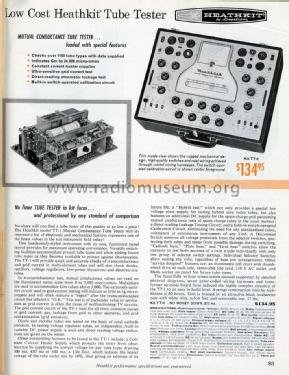
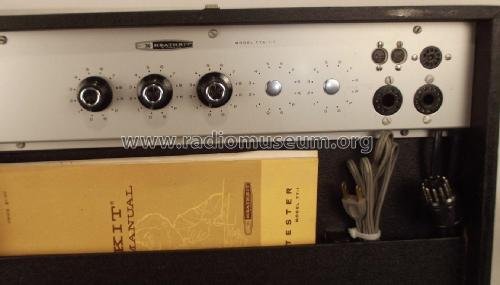
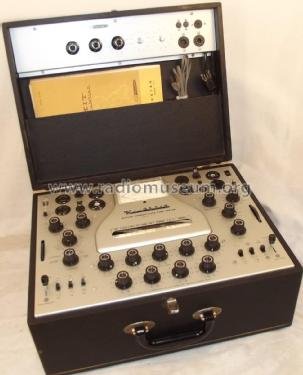
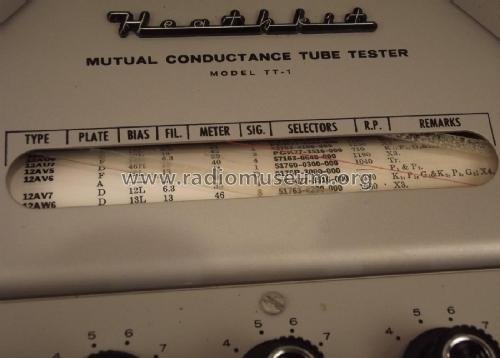
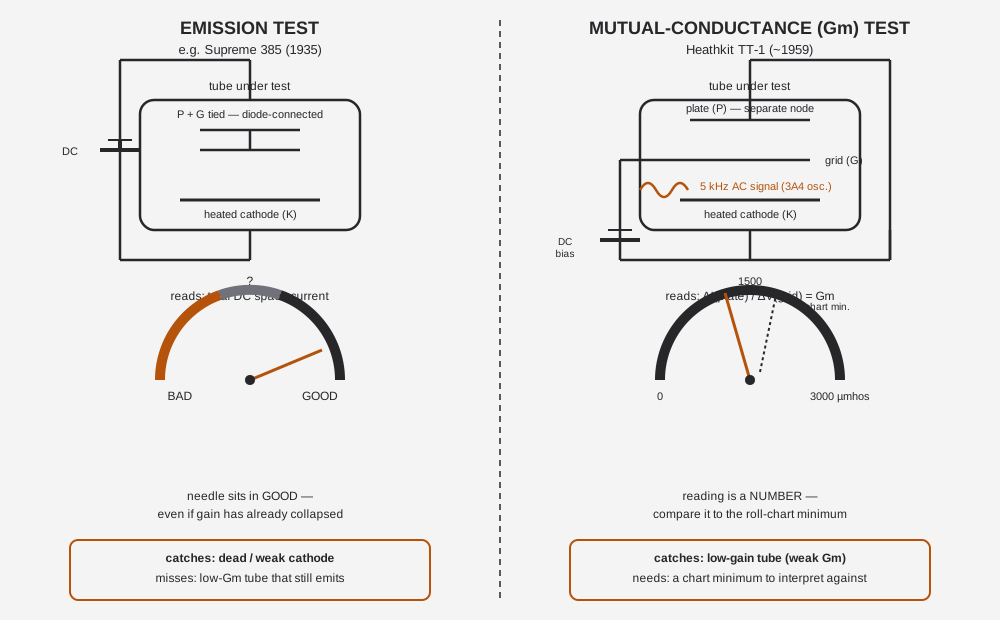
The Heathkit TT-1 (~1959–60, a kit) is Heathkit's flagship dynamic tube tester — a true mutual-conductance (Gm) tester: a separate 5 kHz oscillator (a 3A4 tube) injects a small AC grid signal and the meter reads transconductance directly in µmhos (0–3000, to ~24,000 with multipliers), compared to the built-in roll chart's reject minimum. A built-in illuminated roll chart + per-pin selector switches + P/G/K bus switches set up each tube's plate/screen/bias. Also does shorts/leakage, a grid-current/gas test (12AV6 detector), a life test (heater −10%), and a VR-tube test — and it's self-calibrating (no reference tube or external gear needed). A kit redesign of the professional Weston 981-3 (Daystrom owned both Weston and Heath). Paired on Jeff's bench with the Supreme 385 emission tester — the Gm side of the emission-vs-Gm contrast (the TT-1 catches weak tubes that pass emission).
Context
Mutual conductance (Gm) is the figure of merit for active tube performance — emission testers (like the Supreme 385) measure only whether the cathode is still emitting and don't catch a tube whose Gm has fallen below useful. The TT-1 catches weak tubes that pass emission. Common service issues (from the manual + Nickerson's refurb report): recap all electrolytics; the silicon CR-101 rectifiers are not rugged and commonly fail (replace with 1N4007) — this is silicon, not selenium; 🔴 the 3-section AC (filament-current) cap is a known hazard — it rises in value with age (can triple filament current) and overheats/bulges (Nickerson disconnected it; if replaced, use AC-rated ≥150 VAC film); R20 commonly burns out (a shorting tube under test triggers it); deoxit the switch bank + selectors + sockets; clean/re-zero the meter; preserve the 0.22 µF 2% calibration cap. Calibration is self-contained (the CALIBRATE switch — BIAS/SIGNAL/METER — needs no reference tube).